COMMON SENSE Represented at “Water: The Greatest Global Challenge”

Dublin City University (DCU) researchers Dr Margaret Mc Caul and Eoghan McNamara represented the COMMON SENSE project at the international DCU Water Institute Conference, entitled “Water: The Greatest Global Challenge”, held at DCU's Innovation Campus on 27-28 November 2014.

The aim of the two-day conference was to bring together leaders in R&D along with key stakeholders to address water challenges and discuss the key drivers and solutions for the water industry.

COMMON SENSE is an EC-funded project that aims to provide a cost effective reliable sensing platform for in-situ measurements of key parameters relating to eutrophication, contaminants, marine litter and underwater noise. The project will design and develop new generation sensors focused on the detection of: nutrient analytes by utilising established colorimetric chemistries for phosphate, ammonia, nitrate and nitrite; low concentrations of heavy metals (lead, mercury, cadmium, zinc and copper); surface concentration of micro plastics; and underwater noise.

Dr Mc Caul and Mr McNamara presented a poster at the water conference which focused on the development of an autonomous sensor as part of the COMMON SENSE project for the in-situ detection of nutrients, using colorimetric chemistries for nitrite and nitrate. Nutrients such as phosphate, ammonia, nitrite and nitrate are central in many environmental processes within the marine environment, including several microbial, plant and animal metabolic processes. The research included the development and use of a novel bench top system that allows each individual component to be tested prior to integration into the deployable system.
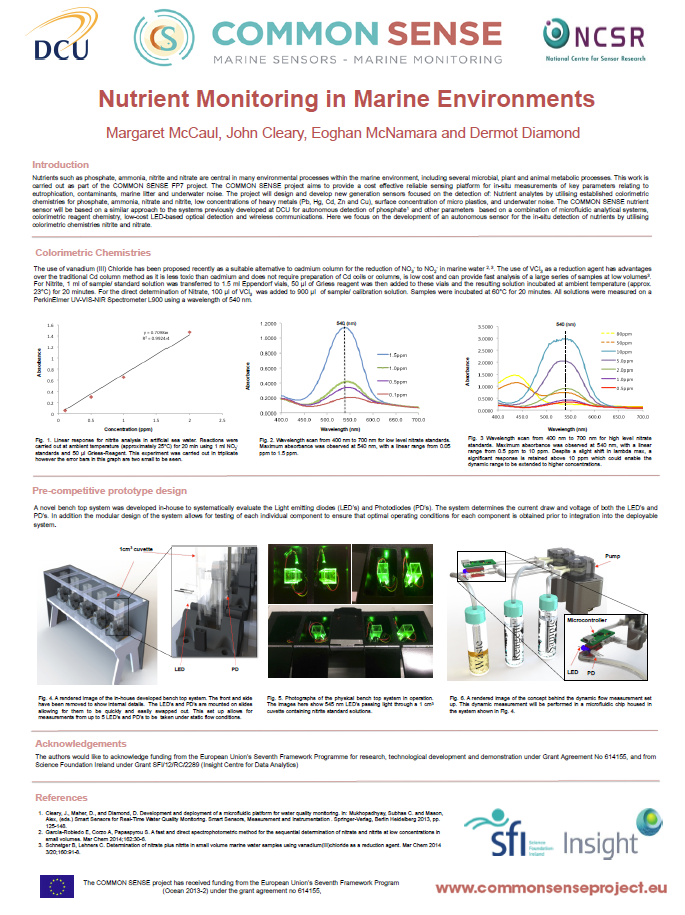
Capture of DCU poster

COMMON SENSE Represented at 2nd IORC in Barcelona

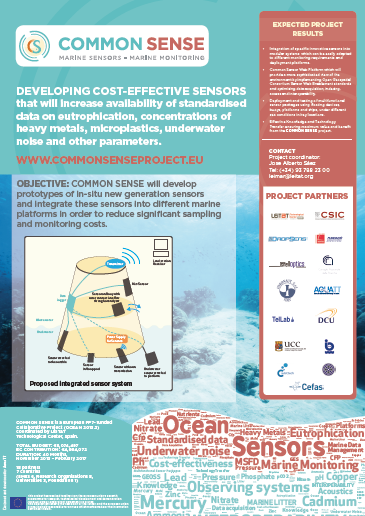
COMMON SENSE partners attended the 2nd International Ocean Research Conference (IORC) in Barcelona from the 17th to the 21st of November, where they exhibited an informational poster on the project and its aims.

Members of the partnership also attended a number of workshops at the event, including “European marine policy and its implementation through projects for marine monitoring for blue growth” which was organised by CYRIC (Cyprus Research and Innovation Center).

This workshop gathered together the four projects financed under the EC Seventh Framework Programme (FP7) topic “Innovative multifunctional sensors for in-situ monitoring of marine environment and related maritime activities”: SENSE OCEAN, SCHEMA, NEXOS and COMMON SENSE; as well as other innovative projects such as MARIA BOX, BRAAVOO, ENVIGUARD, SEA-ON-A-CHIPand SMS.

The consortium was also represented at a parallel workshop on “Achievements and future research on micro-plastics in the marine environment” as well as at the “Presentation of the Group of Experts on the Scientific Aspects of Marine Environmental Protection (GESAMP) report in reference to microplastics”. The core research of COMMON SENSE includes the design, development and integration of a cost-effective sensor for in-situ monitoring of microplastic fraction within marine litter.

Furthermore, the consortium attended the workshop on “Scientists sharing data: existing databases, improving access, data poor areas”.

COMMON SENSE Poster


COMMON SENSE Consortium Discuss Effective MSFD Implementation

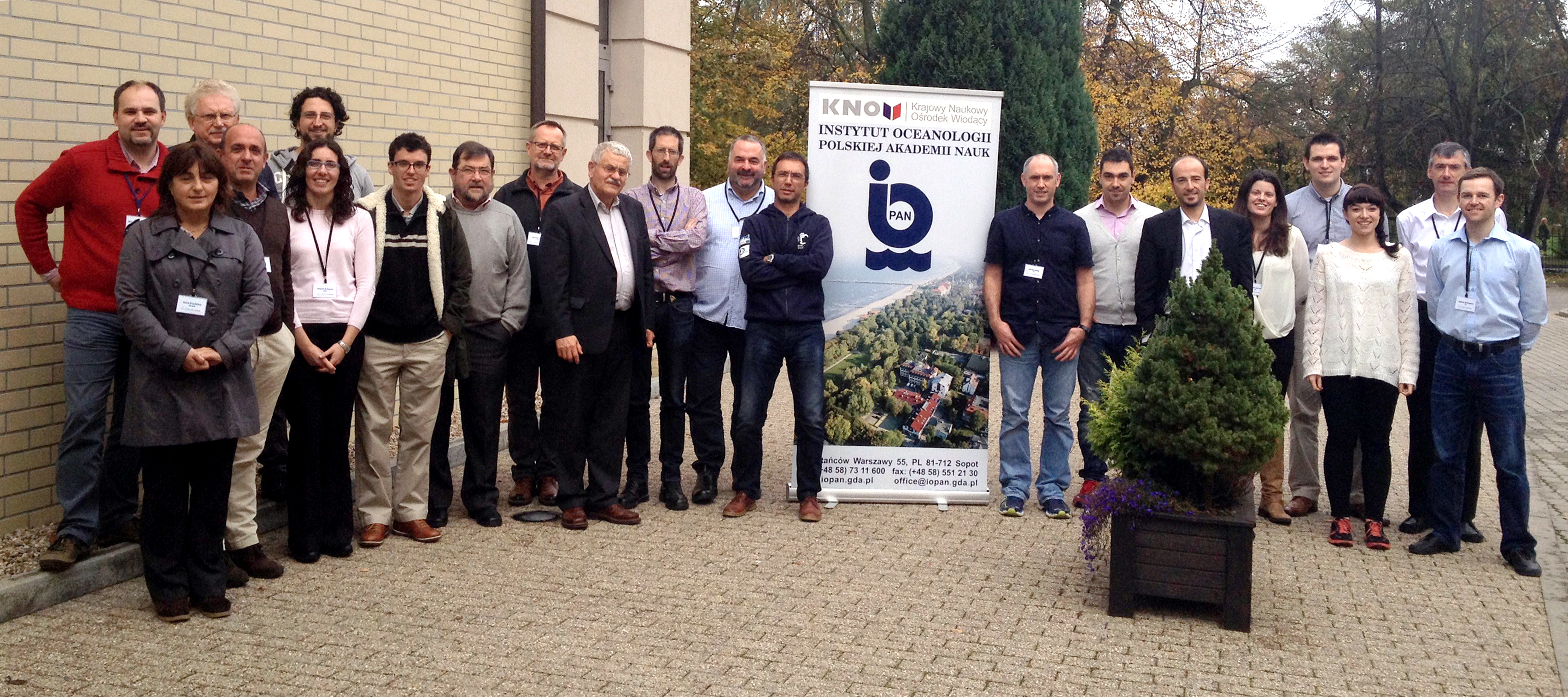
The COMMON SENSE project’s annual partner meeting was held in Sopot, Poland, from 14-16 October 2014. The meeting, hosted by the Institute of Oceanology of the Polish Academy of Sciences (IOPAN), brought the COMMON SENSE consortium together to discuss the progress of the project and to partake in collaborative workshops. 

COMMON SENSE aims to develop innovative, cost-effective sensors that will increase the availability of standardised data on: eutrophication; concentrations of heavy metals; microplastic fraction within marine litter; underwater noise; and other parameters such as temperature and pressure.

During the meeting, partners engaged in participatory policy workshops where they collaborated to identify the most significant barriers to implementation of the Marine Strategy Framework Directive (MSFD). This was followed by an extensive review meeting where the progress of each of the project’s work packages was presented and evaluated in order to ensure good project development, the achievement of project objectives, and the successful delivery of project results.

Jose Alberto Saez, COMMON SENSE Project Coordinator, said: "The COMMON SENSE project aims to provide the latest generation of sensing technologies to support the effective implementation of the MSFD. During this first year of work, we have established the basis for cooperation between the multi-disciplinary and multi-national project team that will enable the achievement of our ambitious goals and will ensure the success of this exciting initiative."

 COMMON SENSE partners at annual meeting in Sopot Poland

Photo Caption: Members of the COMMON SENSE consortium at the project’s recent 12-month partner meeting in Sopot, Poland.

Under the MSFD, EU Member States are expected to assess the overall status of their marine environments and to put in place the necessary measures to achieve Good Environmental Status (GES) by 2020. Member States must implement cost-effective monitoring programmes in order to achieve MSFD monitoring objectives, as well as other European maritime and environmental policies such as the Common Fisheries Policy (CFP). Through the development of automatic, low maintenance and efficient sensors, the tools provided by the COMMON SENSE project will support effective monitoring of our waters and so help protect the marine environment in Europe, enabling a sustainable use of them.

The COMMON SENSE consortium comprises six SMEs, five research development institutes, three universities and one foundation. The consortium’s expertise and geographical distribution will enable multidisciplinary marine environmental monitoring of key marine regions, including the Baltic Sea, the north-east Atlantic Ocean and the Mediterranean Sea.

For further information about COMMON SENSE, please contact COMMON SENSE Coordinator LEITAT Technological Centre www.leitat.org, by means of the Maritime Division (leimar@leitat.org). 


Mid-term evaluation report on INSPIRE implementation launched


The EEA (European Environment Agency) has published a mid-term evaluation report on the implementation of the INSPIRE directive. The report looks at the implementation of the directive and its relevance, and discusses any fine-tuning necessary to fully meet its initial objective of creating an infrastructure to share spatial data and services in Europe supporting environmental policies and policies that have an impact on the environment.

The full report is available to view and download here.


International Innovation "Sensing Change" Edition

International Innovation Issue 159 profiles the technological developments which have led the environmental sciences towards a new era in data collection. This edition covers a range of exciting developments in monitoring techniques and applications for the latest sensor technology.

You can access this edition free of charge, after a short registration process here.

EC flag The research leading to these results has received funding from the European Union’s Seventh Framework Programme (FP7 /2007-2013) under grant agreement no 614155. This publication reflects the views only of the author, and the European Union cannot be held responsible for any use which maybe made of the information contained therein.